

Not this one, but the one before it — our WWII costume guide covers what's actually buyable today. This is the pure history version for the war before that: what British soldiers genuinely wore in the trenches, and why it looked the way it did.
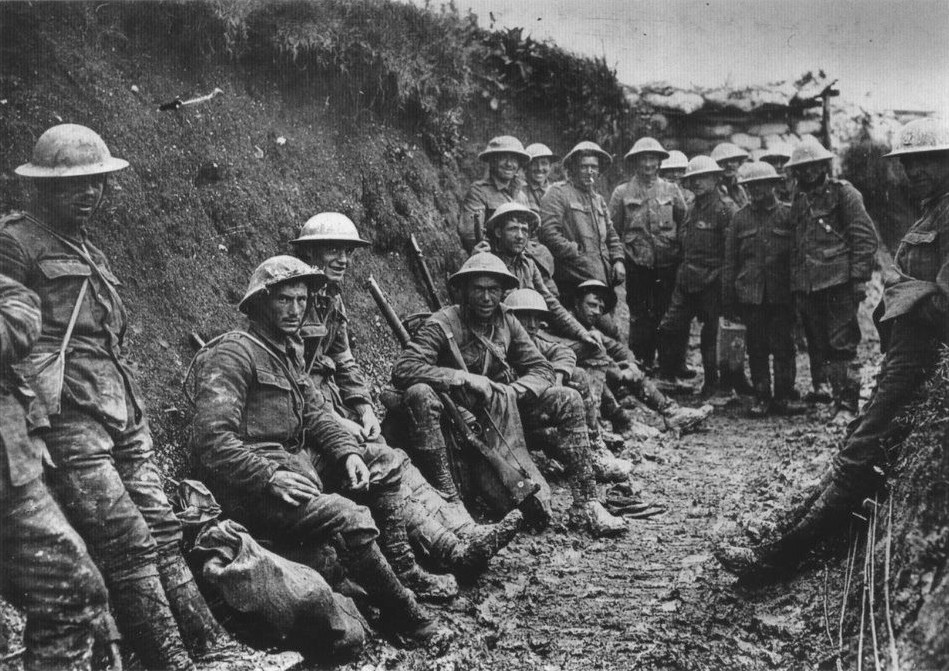
Royal Irish Rifles ration party, Battle of the Somme, July 1916 — Service Dress, puttees and the newly-introduced Brodie helmet all visible. Imperial War Museums, public domain (Crown Copyright expired).
1902 Service Dress: already in place before war broke out
The khaki wool Service Dress that defined the British WWI soldier's silhouette was actually adopted in 1902, well before the war started, replacing the old scarlet coats for active service — khaki had already proven itself far more practical (and far less visible to the enemy) during the Boer War. By 1914 it was the standard combat uniform, not a wartime emergency measure.
Puttees: the wrapped-leg look
Those long strips of cloth wound around the lower leg from ankle to knee — puttees — were standard issue throughout WWI, providing support, protection from mud and debris, and a snug fit that stopped trouser legs flapping or snagging. They were fiddly to put on correctly and took genuine practice to wrap well, which is part of why they eventually fell out of use in favour of simpler alternatives as boot and trouser design improved. See our dedicated puttees guide for the full story of why they disappeared.
The Brodie helmet: a mid-war lifesaver
For the first year and a half of the war, British troops had no steel helmet at all — just soft caps, offering no protection from shrapnel. The shallow, wide-brimmed steel Brodie helmet was introduced from 1915 into 1916, a genuinely significant change that measurably reduced head-wound casualties. Its distinctive "dish" shape remained in British service, updated, right through WWII too.

British troops in Brodie steel helmets, fully equipped, moving along a communication trench, 1918. National Library of Scotland, no known copyright restrictions.
Why this matters for accuracy
If you're researching or collecting WWI specifically, the exact combination — pre- or post-Brodie helmet, puttee style, Service Dress pattern — can help date a photo or piece of kit to a fairly specific window within the war. Small details, but they carry real information.
See our companion piece on what's genuinely available for a WWII look today, or email us at sales@jungleuk.com with any specific questions.
1908 Pattern webbing: Britain got this one right
Before 1908 a British soldier carried his kit on a leather belt with pouches hung off it, and the weight dragged on his hips and shoulders. The 1908 Pattern Web Infantry Equipment changed that completely.
It was a single integrated set of woven cotton webbing — belt, braces, ammunition pouches, haversack, water bottle carrier and entrenching tool — designed so the load sat across the whole torso. Crucially it could be put on and taken off as one piece, which mattered enormously to a man who might need to shed 60lb of kit in seconds.
The Germans and French were still using leather. British webbing was better, and everyone else eventually copied the idea.
Before the helmet, a soft cap
For the first eighteen months of the war British soldiers went into action in a soft peaked Service Dress cap. No protection whatsoever — it was headwear, not equipment.
By late 1914 many had adopted a soft "gor blimey" trench cap with fold-down ear flaps for winter warmth. Warmer, still no protection.
The scale of head wounds from shrapnel bursting overhead is what forced the change. The Brodie helmet was not a refinement of existing kit; it was a response to a specific and appalling casualty statistic.
Boots, and the state of men's feet
The standard issue was the B5 ammunition boot — heavy black leather, hobnailed sole, steel-shod heel. Sturdy, well made, and completely unsuited to standing in water for days.
Trench foot became a disciplinary matter as much as a medical one. Officers were held responsible for their men's feet, whale oil was issued for rubbing into them, and units rotated out of the line partly so boots could come off and socks could dry.
The greatcoat: the most hated item in the Army
Thick wool, ankle length, and superb in the cold. The problem was rain. A dry greatcoat weighed around 7lb; a soaked one could reach 20lb, and a man wearing one could barely climb a trench ladder.
Soldiers routinely cut them down or abandoned them, and the sheepskin and goatskin jerkins issued from 1914 onwards were an attempt to solve the same problem with less weight.
How you told anyone apart
WWI Service Dress carried remarkably little identification by modern standards. Brass shoulder titles gave the regiment. Rank went on the sleeve for other ranks and on the cuff for officers — which made officers conspicuously easy for snipers to identify, so by 1917 many had moved their rank to the shoulder and adopted other ranks' tunics.
Battalion and formation signs — the coloured patches that would cover a WWII uniform — only came into widespread use late in the war.
What you can actually buy today
Very little, honestly. Genuine 1914-18 uniform is museum material now. What survives is largely in collections, and what does come to market is priced accordingly.
Reproduction is the realistic route for re-enactment, and good repro is genuinely good — the specifications are well documented and the makers who serve that market know what they are doing.
Where we can help is the things that did not change: brass buttons, cap badges of regiments that still exist, greatcoats of a later pattern that give the same silhouette, and the general vocabulary of British military kit. If you are building a WWI impression and want to know what is worth buying genuine and what is not, ask us — we would rather tell you honestly than sell you the wrong thing.
Shop the kit
Everything below is genuine surplus, in stock now.

