

Our other WWII piece is about what you can actually buy today for a 1940s look. This one's the history behind it — what British troops genuinely wore, and why Battledress was such a big shift from what came before.
Battledress: a genuinely modern rethink
The 1937 Pattern Battledress replaced the old Service Dress with something shorter, simpler and cheaper to produce — a waist-length blouse and matching trousers, designed for practical field wear rather than the more formal cut of WWI-era uniform. It was one of the first uniforms designed with mass wartime production genuinely in mind from the outset.
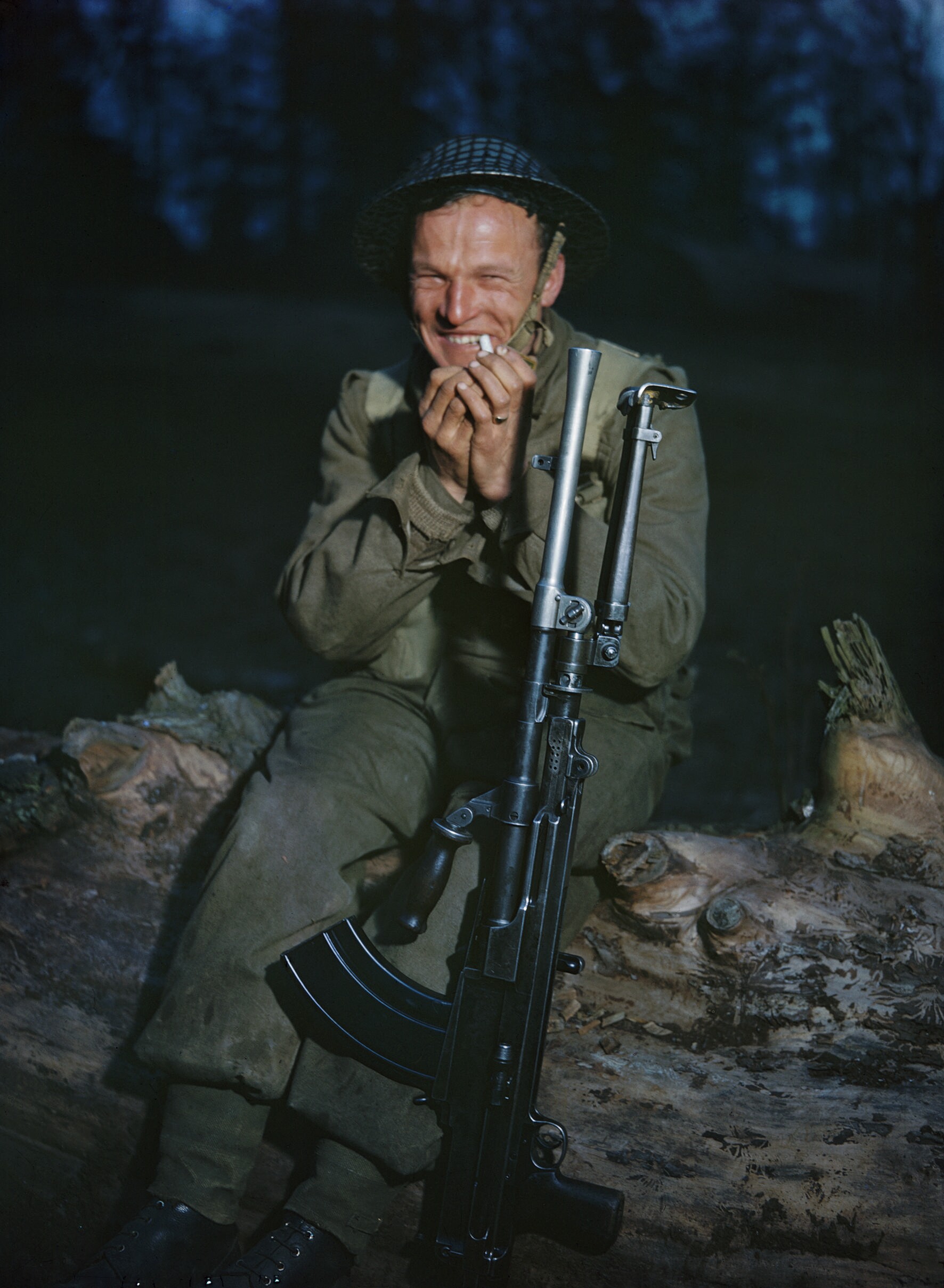 A British infantryman in wartime Battledress and 37 Pattern webbing, training in the UK, March 1944. War Office official photograph, public domain.
37 Pattern webbing: the load-carrying system
Alongside Battledress came the 1937 Pattern webbing set — a full canvas belt, straps, ammunition pouches and pack system designed to distribute a soldier's kit weight properly across the body rather than just hanging it off a single belt. It was in genuine widespread use throughout the war and for years after, which is exactly why real 37 Pattern pieces still turn up in surplus today.
 Genuine 37 Pattern webbing frog — part of the real wartime load-carrying system.
Shop genuine 37 Pattern webbing →
The helmet: an update, not a redesign
The WWII-era Brodie-pattern helmet (the Mk II) was a refined update of the WWI original rather than a completely new design — same recognisable dish shape, improved liner and strap. It stayed in British service, remarkably, right up until the 1980s in some roles.
What went underneath and around it
Battledress was worn over a collarless shirt, and finished from wool serge that offered decent warmth but genuinely poor water resistance — which is exactly why a separate greatcoat or gas cape was standard issue for wet or cold conditions rather than relying on Battledress alone. Denim overalls (working dress rather than combat dress) were also widely issued for dirty or heavy work, kept separate from the wool Battledress to preserve it for parade and general duty.
Regional and role variation
Not every soldier wore identical kit — different theatres (temperate Europe vs North Africa vs the Far East) and different roles (infantry vs armoured vs airborne) had genuine variations in cut, colour and equipment, which is part of why WWII-era genuine pieces vary so much even within a single year. Desert-weight uniform in North Africa, for instance, was cut from lighter material and often a different shade entirely from the temperate-climate Battledress worn in Europe, for the straightforward reason that wool serge designed for a British winter is the wrong kit for an Egyptian summer.
See our companion piece on what's genuinely available today for a WWII look if you're building a specific impression, or email us at sales@jungleuk.com.
The 1940 Austerity Pattern: when Britain ran out of money
The original 1937 Pattern Battledress was well made — concealed buttons, pleated pockets, a proper fly front. By 1940 Britain could not afford it.
The 1940 Austerity Pattern stripped it back: exposed buttons instead of concealed plackets, no pocket pleats, simpler cuffs, and a coarser, lower-grade serge. It looks noticeably cheaper because it was, and it is the version most soldiers actually wore for most of the war.
For anyone dating a Battledress blouse, this is the first thing to look at. Concealed buttons means early war or officer's private purchase; exposed buttons means austerity.
Ammunition boots and anklets
The hobnailed ammunition boot carried over from WWI largely unchanged, but what went above it did not. Puttees were gone, replaced by the web anklet — a short buckled canvas cuff that did the same job in a fraction of the time.
That change alone saved every soldier several minutes a day, twice a day, for six years. Small things scale.
The Denison smock
Airborne forces got their own garment, and it became one of the most influential pieces of clothing the British Army ever produced. The Denison smock was a long, loose, hand-painted camouflage overgarment pulled on over Battledress, with a "beaver tail" flap that buttoned between the legs to stop it riding up during a parachute descent.
It was the first genuinely camouflaged British combat garment issued at scale, and its DNA runs straight through to every smock the Army has used since.
Khaki drill: the other war
Battledress was designed for north-west Europe. In North Africa, Italy, Burma and the Middle East it was unwearable, and troops there wore khaki drill — lightweight cotton in shorts and shirt, with the drill bush jacket for officers.
Photographs of the Eighth Army show something that looks almost nothing like the popular idea of a WWII British soldier: shorts, rolled sleeves, and a remarkable variety of locally acquired kit that regulations never quite caught up with.
Formation signs: reading a WWII sleeve
Unlike WWI, WWII uniform was covered in identification. A typical sleeve carried the regimental shoulder title at the top, then the divisional formation sign, then arm-of-service strips, then any qualification badges.
Formation signs are why WWII insignia collecting is such a deep field — the Desert Rats' jerboa, the 6th Airborne's Pegasus, hundreds of others, each one placing a man in a specific division at a specific time.
What you can actually buy today
More than people assume. Genuine wartime-dated pieces do still surface, and we hold some.
1937 Pattern webbing
Made in enormous quantities and kept in service into the 1960s, so most surviving 37 Pattern is post-war manufacture. The wartime-dated pieces are the scarce ones — and the date stamp is what separates them.

Genuine British Made World War Two WW2 37 Pattern Web Pistol Belt Assorted
Shop genuine WW2 37 Pattern webbing →

World War Two WW2 1937 Pattern Issue Web Pistol Belt Buckle Set WW2 British
Shop WW2 1937 Pattern belt buckles →
Vintage No2 dress
Old-pattern khaki No2 dress jackets and trousers turn up in genuinely vintage examples. Cut, buttons and label all help place them, and they are the most wearable period item we handle.

Vintage British Army No2 Jacket Khaki Green Old Dress Pattern WW2 Re-enactme
Shop vintage No2 dress jackets →
Home front insignia
Easily overlooked, and among the most genuinely wartime things in the shop. Civil Defence and Welfare patches were made and worn 1939–45 and never reissued afterwards, which makes them unambiguously of the period in a way most uniform is not.

Genuine British Army WWII WELFARE Patches / Badges x 2 - NEW

Genuine British WWII CIVIL DEFENCE INSTRUCTOR Patches / Badges x 10 - NEW
Shop WWII Civil Defence insignia →
How to tell wartime from post-war
- Date stamps. British webbing and equipment was usually date-stamped. A "1943" stamp settles it; a 1952 stamp settles it the other way.
- Broad arrow. The War Department broad arrow mark, often with a maker's code beside it.
- Buttons. Wartime economy buttons differ from post-war ones, and on Battledress the concealed-versus-exposed button question dates the pattern.
- The label. Where one survives it is the single best evidence, and it is the first thing we check.
Where we know an item is wartime-dated we say so in the listing. Where we are selling a later pattern that gives the same look, we say that too — the difference matters to a collector and it should be stated, not implied.
Shop the kit
Everything below is genuine surplus, in stock now.

